
Sometime this past year, without much ceremony, the primary visitor to a growing number of websites stopped being a person. Shopping agents browse catalogs, compare offers, and complete checkouts. The payments industry spent the last several months standing up protocols for exactly this, agent-initiated discovery, negotiation, and purchase, with the major networks and platforms each planting a flag. Merchants are now restructuring storefronts so that software can traverse them, because that is where the buying increasingly starts.
I keep turning this over from the design side, because almost everything I know how to do assumes a human on the other end of the screen, and the screen is becoming optional.
What design is, when nobody is looking
Strip a well-designed service page to its functions and you find three jobs. It informs, here is what this is and what it costs. It persuades, here is why it fits you. And it reassures, here is what happens next, here is who to call, you are in the right place, you are almost done. Decades of craft live in those three jobs, hierarchy, progressive disclosure, microcopy, the calm a good form radiates.
An agent acting for a buyer needs the first job done brutally well, as structure. It is indifferent to the second, persuasion aimed at software is either ignored or, worse, becomes adversarial prompt-bait, and the early signs of merchants attempting exactly that are one of the less charming developments of the year. And the third job, reassurance, simply has no recipient. The agent does not need to feel that everything will be okay.
But the person the agent works for still does. That is the design problem I cannot stop staring at. The reassurance, the warnings, the moment of pause before commitment, all of that was load-bearing for the human, and the human is no longer on the page where we built it.
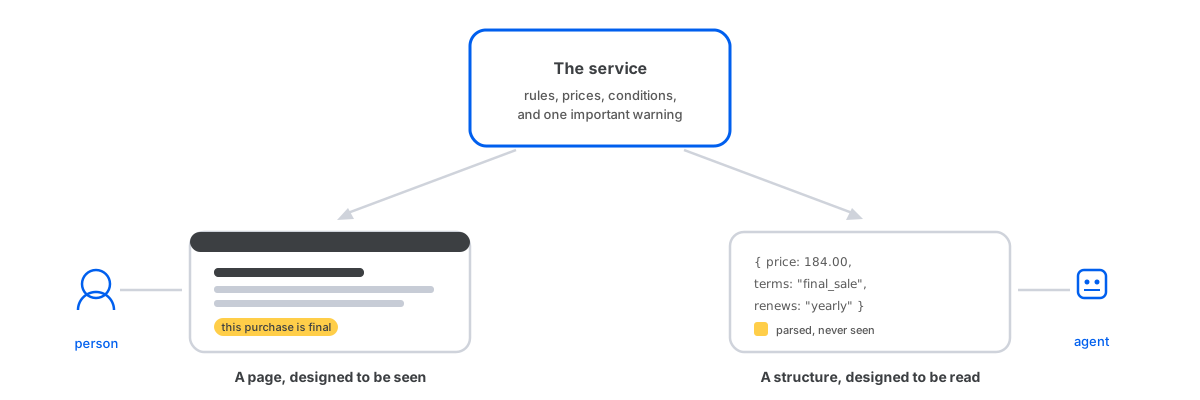
The consent that nobody saw
Here is the sharpest version. A checkout flow contains a screen that says this purchase is final, or this subscription renews annually, or this seat is non-refundable. We designed that screen so a person would see it at the moment of decision. When an agent completes the purchase, the disclosure was technically present, machine-readable, dutifully parsed. The human principal never saw it. Where did the informed part of informed consent go?
The current answer seems to be that the agent should surface important things back to its principal, and the protocols make room for that. I do not find this fully reassuring, because the agent's judgment of important and the service's judgment now stand between the person and the conditions they are agreeing to, and both have incentives. A service that owes a person a warning used to discharge that duty with a screen. What discharges it now is genuinely unsettled, and I suspect it will take a regulator or a lawsuit to settle it.
Public services make this unavoidable
For commerce this is mostly a consumer-protection story. I spent years designing government services, and there the stakes change character. Imagine the agent is applying for child care benefits on behalf of an exhausted family, a use case that is coming whether agencies prepare or not, because the families with the least time and language access have the most to gain from delegation.
A benefits application is full of moments we designed for human comprehension. A question whose answer affects waitlist standing. A choice that triggers a heavier documentation burden later. A disclosure about how income gets verified. When software navigates those on a family's behalf, the family may get an outcome without an understanding. An approval a family cannot explain is fragile, they cannot recertify confidently, cannot spot an error in it, cannot defend it if challenged.
In public services, the understanding is part of the service.
And yet, refusing agents would be its own failure. The honest accounting says human-only access has been failing quietly forever, the families who never apply because the form defeated them are the original accessibility gap, and a good agent could be one of the most powerful accessibility technologies a benefits system has had. I find I cannot be against this. I can only be against doing it carelessly.
What I think transfers
So what does a designer actually do about a user who is not a person? My early answers, all held loosely.
The information architecture work survives and gets harder. Making a service legible to software is largely the same discipline as making it legible to people, taken seriously enough to be testable. If your eligibility rules cannot be expressed cleanly to a machine, they were probably not clear for humans either, the humans just absorbed the ambiguity in silence.
The reassurance work does not die, it relocates. Somebody has to design what the principal sees, the digest of what was agreed, the warnings that must survive the journey from service through agent to person, the receipt that explains itself a year later. That artifact barely exists today. It could become one of the defining design objects of the next few years, and nobody owns it yet, the services say it is the agent's job, the agents say it is the platform's.
And verification becomes a first-class surface. The person's real interaction shifts from doing the task to checking what was done for them, which means the design of review, of diffs against intent, of graceful undo, moves from the periphery of our craft to its center.
I could be wrong about the pace. Agent commerce numbers are still small against the whole, and people have predicted the death of the storefront before. But I notice the protocols arrived before the demand fully did, which is the order of operations infrastructure follows when the builders are confident. Design built its house on the assumption that a person sees the screen at the moment it matters. That assumption now has an expiry date I cannot read, and being early to this question seems wiser to me than being punctual to its consequences.